
Silica is everywhere. It occurs naturally in rocks, sand, clay and more. For most of us, it’s just a part of nature. But if you work in the trades, specifically in construction, stone cutting, countertop fabrication, mining or on railways, silica can be deadly.
The most common form of silica is quartz, found in granite, concrete, and sandstone. Often, quartz consists of 90% silica dust combined with resin. Cutting, grinding, or drilling quartz releases tiny particles called respirable crystalline silica or silica dust into the air. These particles are 100 times smaller than a grain of sand, making them undetectable and easy to inhale. Once inside your body, the particles reach deep into your lungs, causing irreparable damage.
According to the Associated Press, “Silica dust is 20 times more toxic than coal dust and causes severe forms of black lung disease even after a few years of exposure.”
Silica dust can cause significant and long-term damage and is linked to many serious health conditions, such as silicosis, progressive massive fibrosis, lung cancer, and coal workers’ pneumoconiosis, commonly called “black lung” disease. Black lung disease is a broad term encompassing progressive massive fibrosis, silicosis, lung cancer, chronic obstructive pulmonary disease, and kidney ailments.
Occupations at risk for developing respiratory issues, lung disease and silicosis include but aren’t limited to the following:
Silica dust has silently crept into the lungs of unsuspecting workers for centuries, cutting short the lives of countless workers. Here’s a brief timeline:
Currently, about 2.3 million professionals face exposure to crystalline silica at work. The situation is at an all-time high in L.A. County, where elected officials are considering a potential ban on selling and installing this “silica-based engineered stone.” This substance, often called artificial or imitation stone, is composed of crushed quartz, made with up to ninety percent silica dust, held together with resin.
Take the story of Rodriguez, a 42-year-old worker, one of the first known individuals in the U.S. to fall victim to silicosis due to countertop work. Lured by a better paycheck, he changed jobs, never anticipating the dire consequences. By 2019, he was hooked up to an oxygen tank for six hours a day. Reflecting on his decision, he says, “That change ruined my life. It wasn’t just me. It was the whole company — that they don’t protect their employees.”
Imagine seeing your loved one come home every day covered in white dust. That was Victor. After work, he looked like he’d been in a snowstorm. Even his eyelashes were dust-filled. Most people would brush it off, thinking it’s just part of the job. But that dust was more dangerous than anyone thought. Victor went from a strong guy weighing 230 pounds to only 125 in just two years. His body was ravaged by silicosis. As his wife Miriam recounts, “My mom still cries all the time, even now. And so do I. It is hard for us. A year has passed, but I feel like it happened yesterday. We cannot get over it.”
In 2023, NBC spoke about silicosis with Arthur Frank, professor of environmental and occupational health at Drexel University. “[Silicosis] is an absolutely horrible, preventable, work-abusive situation that never should have occurred,” said Frank. The coverage also included input from Dr. Jane Fazio, a pulmonary specialist at Olive View-UCLA Medical Center, who co-authored a study about the rise of silicosis among young countertop fabricators in California.
Regulations and workplace standards are crucial in preventing silica exposure. Personal protection equipment is also essential. Experts advise the following tools to help prevent and control silica dust.
Protecting your health and safety is essential if you come into contact with silica dust on the job. If you work for a responsible company, workplace monitoring and engineering controls like wet methods, exhaust ventilation, and the continuous measurement of silica levels will help you stay safe. Still, the final line of defense is you.
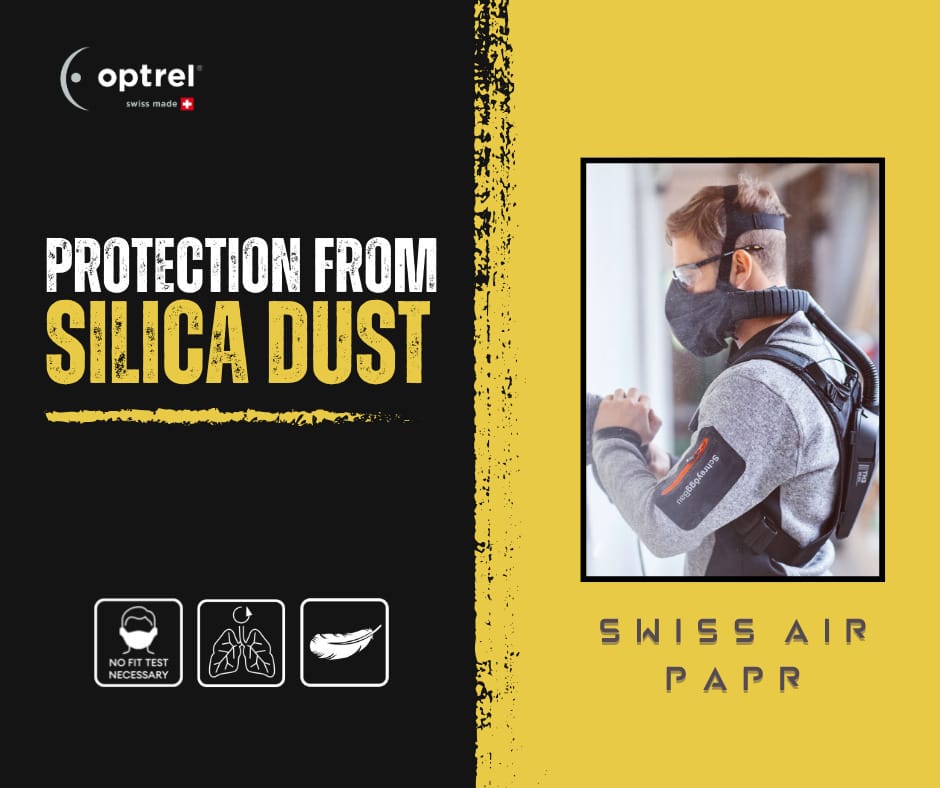
When it comes to your health, do not take chances. One of the best ways to protect yourself against silica dust is with a PAPR (powered air-purifying respirator) system. Optrel offers two PAPR systems, each offering unique benefits.
We have two PAPR systems designed to protect against silica dust. Both systems feature a TH3 HEPA filter for superior protection.
The Swiss Air is the most versatile PAPR on the market.
The e3000x PAPR provides superior protection and unparalleled power.
The devastating effects of silicosis are real and have persisted across generations. Waiting for industry regulations to catch up or hoping your company has stringent engineering controls and workplace monitoring is not your only answer. As we acknowledge past tragedies and confront present challenges, change must come at all levels, from policymakers to employers to individual workers. We all play a part in prioritizing health and safety to eradicate this entirely preventable disease. The emphasis on personal responsibility cannot be stressed enough.
Optrel’s Swiss-made PAPR systems offer the highest-quality protection against silica exposure. Personal responsibility is paramount in protecting yourself. If you work with silica dust, now is the time to check out optrel’s PAPR systems.